|
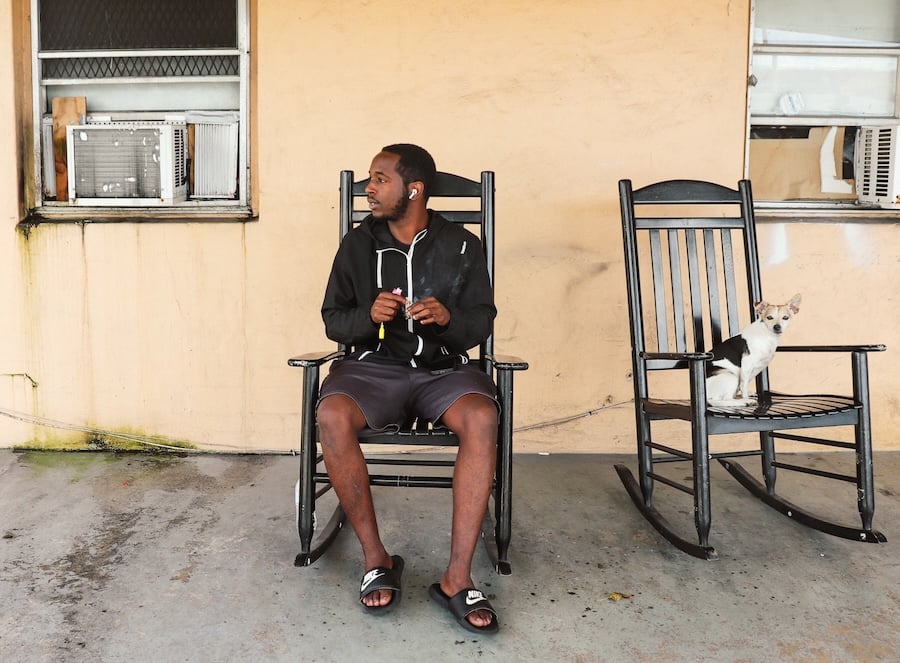
This past March, I met 22-year-old Isaiah Grimes as he sat outside his apartment in Miami’s Edison Courts public housing complex. His tiny dog sat in a chair next to him as we talked about the place he called home. The father of two has spent the majority of his life bouncing between public housing complexes with his mother. He argued he knew the “real Miami” — not the glitzy, glamourous “Diddy and DJ Khaled version” — better than anyone.
And that also meant he understood how it was changing.
Since 2010, Miami has lost almost half of its Black residents as gentrification has exploded across the city. Along one block of 61st Street near his home, I walked past 12 buildings in a row that were either under construction or had a sign advertising new, higher rents.
Isaiah told me that to truly understand his city, you have to look beyond its biggest tourist attraction. “What's on the beach, that's on the beach,” he said, “but what we go through here in Miami is really bad.”
Climate change is a part of the reason why.
With rising seas threatening oceanfront properties, developers and wealthier residents are rebranding long-neglected Black neighborhoods like his as the new safe bet. The same redlined, inland areas that confined Black families to higher ground are now being marketed as “up-and-coming” — and long-term residents are paying the price.
In my latest piece, I follow Isaiah and his neighbors as they navigate this new reality: landlords clearing out buildings for renovations, rent hikes that double almost overnight, and a city that leads the nation in all-cash investment offers on homes.
For residents like Isaiah, climate change doesn’t show up first as a hurricane or a king tide. It is showing up as gentrification: an eviction notice, a demolished public housing building, and as a developer with a cash offer. It shows up as a neighborhood where the faces on the block start to look different, while the people who built that community are pushed farther away from opportunity, transit, and safety.
Isaiah’s story is one of many, but it reveals a pattern stretching across Miami and other coastal cities: Black communities are being asked to absorb the costs of a crisis they did not create, all over again. And it is already happening in places like Charleston, South Carolina; Norfolk, Virginia; and Houston — and maybe your neighborhood next.
You can read the full story here, learn more about how climate change is reshaping Black Miami, and hear directly from residents who are offering solutions.
|